

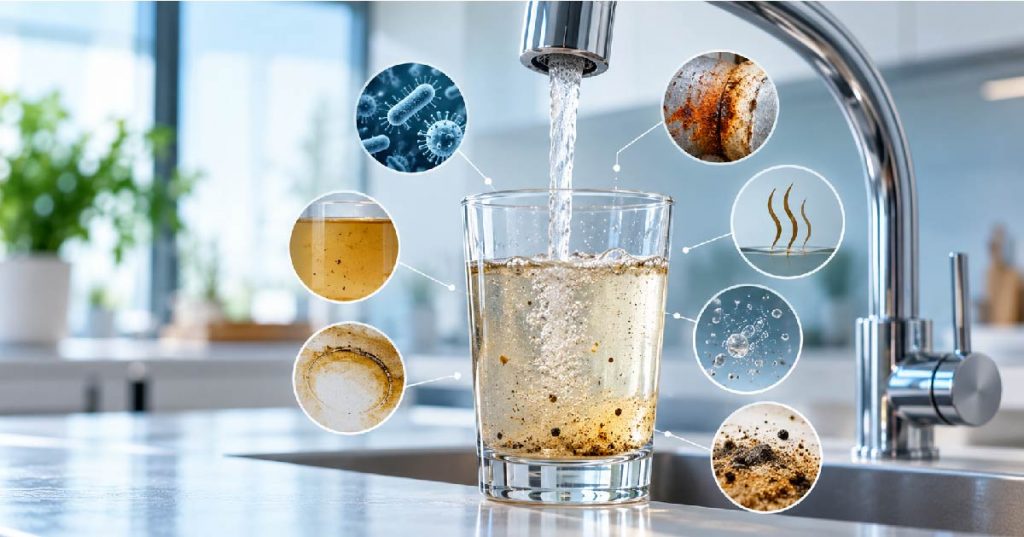
Water can look perfectly ordinary and still contain something you would rather not drink. That is what makes contaminated drinking water difficult to judge at home, in a commercial facility or even across a community supply.
There are occasions when one can tell that something is wrong by pursuing different signs such as strange smells, cloudy appearance or metallic taste. However, sometimes water does not show any visible signs of pollution.
Microorganisms, dissolved chemicals and natural substances, such as, for example, arsenic, can present in a contaminated water but do not change the water in any way. It is generally recognized by more authoritative organizations such as WHO that microbial contamination is one of the most important threats to the safety of drinking water.
1. The Water Suddenly Looks Cloudy
A glass of water that has become noticeably cloudy deserves attention, particularly when the change is new or persistent.
Cloudiness, technically known as turbidity, can come from suspended clay, silt, organic matter, microorganisms or precipitated metals such as iron and manganese. It may also result from poor source-water conditions, inadequate treatment or problems within the distribution network.
Not every cloudy glass automatically means the water is dangerous. Air bubbles, for example, can temporarily make tap water appear milky. But unexplained or persistent turbidity is one of the more visible signs of contaminated water and should not simply be ignored.
2. Its Colour Has Changed
Safe drinking water is generally expected to be clear and visually acceptable. Yellow, reddish-brown, blackish or unusual coloration tells you that something has changed.
The presence of iron and manganese can cause discoloration in water by making it brown or dark. The presence of organic matter can also affect the color and the disturbance of water mains can result in the release of settled sediments.
The key point is the occurrence of the change.
If the water that has always been clear begins arriving is a different color, it is important to find out what is causing that change before continuing to use the water for drinking. When water contamination has been detected quickly, it is much easier to solve the problem.
3. There Is an Unusual Smell
People sometimes dismiss water odour because the water still looks clear. That can be a mistake.
Earthy, musty, rotten-egg, chemical or sewage-like odours can arise for several reasons, ranging from biological activity to problems in the source, plumbing or treatment system.
WHO notes that changes in taste and odour may indicate pollution or a failure somewhere in treatment or distribution, and significant changes should be investigated.
Odour alone cannot tell you which water contaminants are present. It is a warning signal, not a diagnosis.
4. The Taste Is Suddenly Different
You have a good idea of how your usual water tastes, and this is advantageous. That sudden metallic or salty or bitter or chemical flavour could mean a change in dissolved minerals, treatments or pipes, or even the water source. There are several substances that may affect the taste just by their presence in a concentration so low that you can notice a difference of flavour while not being aware of their exact cause.
One important thing to be kept in mind is that excellent taste does not guarantee safety.
There are many harmful contaminants that lack any specific taste. Therefore, taste may indeed signal the need for investigation, but it should never substitute proper water quality testing.
5. Sediment Keeps Appearing in Glasses or Containers
A few particles after plumbing maintenance may be temporary. Repeated sediment is different.
The accumulation of fine sand, rust-coloured material, flakes, or other particles at the bottom of storage vessels indicate suspended solids, corrosion, or other deterioration of the water prior to it reaching the users.
This is one of those signs of contaminated water which is simple enough to normalize it after a period of time. People start sifting the particles out and move on.
A better response is to find out why they are coming in there.
Depending on why they’re entering, it could be clarification, filtration, or a whole different approach to assessing the water supply and distribution system.
Please have the paragraph rewritten while maintaining the essence of the original content:
All action words, including the passive voice forms, should be focused on to yield error-free sentences. Any other forms of errors are not tolerated.
Writing scene and style: General rewriting-Maintain the original meaning while using neutral and standard expressions. Adjust the structure in the middle while keeping the same tone and formality.
Training cuts-off date: September 30, 2023.
6. Fixtures and Containers Develop Unusual Stains
Water leaves clues behind even after it has gone down the drain.
Persistent reddish-brown stains may be associated with iron. Dark deposits can occur with manganese. Heavy scale on taps, kettles or heating equipment can indicate elevated mineral content or hardness.
These deposits do not automatically prove that the water is unsafe to drink. But they do suggest that its chemistry deserves closer attention, especially when staining or scaling appears suddenly.
The useful distinction here is between an aesthetic problem and a health problem. They are not always the same thing. Water quality testing is what helps establish that difference.
7. People Using the Same Water Develop Repeated Illness
This is the warning sign that should be handled most carefully.
Diarrhea, abdominal pains, nausea, and other gastrointestinal symptoms can have a variety of causes and should not be diagnosed from the water supply alone. However, in cases when several individuals using the same source develop similar repeated symptoms, investigating the drinking water contamination along with other possible causes may be appropriate.
WHO provides information that the biologically contaminated drinking water can lead to diseases such as diarrhea, cholera, dysentery, typhoid, and polio.
When dealing with an illness, it is crucial to seek medical advice and testing of the water instead of relying solely on one’s symptoms.
The Most Important Warning Sign May Be No Sign at All
This is the part people often miss.
Contaminated drinking water does not have to smell strange or look dirty. Some microbial and chemical hazards cannot be identified reliably with your eyes, nose or taste buds.
That makes regular water quality testing especially important where water comes from groundwater, borewells, private systems or supplies affected by seasonal variation, ageing infrastructure or nearby industrial and agricultural activity.
Testing should be based on the likely risks associated with the source rather than a generic assumption that all water needs the same analysis.
What Should Water Quality Testing Look For?
No one test can evaluate all the different types of contaminants.
In the course of testing, water samples are examined for indicators such as microbiological parameters, pH levels, turbidity, total dissolved solids, hard minerals, various elements and pollutants.
However, the purpose of testing goes beyond simply producing a laboratory report on water condition.
Analysis of the collected data should affect the treatment process.
For example, solid contaminants in water require a specific treatment method, e.g., filtration, whereas dissolved materials would initiate the implementation of a variety of technologies.
How Ion Exchange Supports Safer Water Treatment
Ion Exchange has operated in Indonesia for more than 30 years and provides water and wastewater treatment solutions for industries, municipalities, communities, institutions and homes. Its Indonesian portfolio includes potable water treatment, filtration, membrane systems and ion exchange technologies.
The significance of this context arises from the fact that there is usually no single solution to a problem of water contamination.
Ion Exchange’s solutions for drinking water can be tailored around the characteristics of the source water as well as around the desired quality of the treated water instead of being limited to the universal purifying method. In addition, the company offers filtration, resins, and broader treatment systems for diverse water quality issues across Indonesia.
Final Thoughts
The clearest lesson is simple: do not wait for water to become visibly dirty before questioning its quality.
Cloudiness, colour changes, unusual taste or odour, sediment, staining and recurring illness can all justify closer investigation. Yet contaminated drinking water can also pass every sensory check and still contain unwanted microorganisms or dissolved substances.
When something changes, test first and choose treatment based on evidence.
If you need help evaluating water quality or identifying an appropriate treatment system, connect with Ion Exchange experts in Indonesia to assess the source, treatment requirement and the right water-management approach.
FAQs
What are the most common signs of contaminated water?
Typical indications are unusual cloudiness, off colours, sediment, taste and odour changes, and new stains around taps. The problem is that some of the contaminants cannot be spotted this way.
Can contaminated drinking water look clear?
Yes. Clarity alone does not indicate water safety, since there could be organisms or harmful chemicals present although no clear signs are observable.
How can I confirm drinking water contamination?
Laboratory-based water quality testing is the reliable way to investigate suspected contamination. The parameters tested should reflect the water source, surrounding risks and intended use.
What causes water contamination?
Water contamination can come from microbial pollution, industrial or agricultural activity, naturally occurring minerals, damaged infrastructure, poor treatment or contamination within the distribution system.
What should I do if my drinking water suddenly changes colour or smell?
Avoid assuming the change is harmless. Investigate the supply or plumbing and arrange appropriate testing, particularly when the change is sudden, substantial or persistent.